
You've Seen the Word. Here's What It Actually Means.
A ₹500 poster and a ₹5,000 giclée print might look nearly identical in an online product photograph. Same artwork, same dimensions, same screen. So what exactly makes one worth significantly more than the other?
The answer lies in the printing technology, the quality of the inks, the paper, and the attention to detail that goes into reproducing the artwork.
Giclée (pronounced zhee-KLAY) comes from the French verb gicler, meaning to squirt or spray. The term describes a specialised fine art inkjet printing process in which microscopic droplets of ink are precisely applied to paper or canvas to reproduce an artwork's colours, details, and tonal variations.
Unlike conventional decorative printing, professional giclée printing is designed with fine art reproduction in mind. The result is an artwork that can offer noticeably richer colour, smoother transitions, and exceptional detail, supported by archival materials intended to last for generations.
Whether you're buying your first abstract painting, exploring traditional Indian art, or investing in museum-quality wall art for your home, understanding giclée printing can help you make a more informed choice.
What Makes a Giclée Print Museum Quality?
The quality of a giclée print begins with two essential components: the ink and the surface on which the artwork is printed.
When combined with high-resolution artwork, professional colour management, and precise printing technology, these materials create prints with exceptional visual depth, fine detail, and long-term durability.
1. Archival Pigment Inks: Richer Colours That Last
One of the most important characteristics of professional giclée printing is the use of archival pigment-based inks.
Unlike conventional dye-based inks, pigment inks contain tiny colour particles that are designed to provide excellent colour stability and resistance to fading.
But longevity isn't their only advantage.
Advanced fine art printers use multiple ink channels to reproduce a broad spectrum of colours, including delicate pastels, deep blacks, rich earthy shades, and subtle gradients.
This makes a visible difference, particularly in artwork containing complex colour combinations.
Think of an abstract painting with overlapping shades of beige, terracotta, rust, and muted gold. A conventional print may flatten some of these transitions, while a professionally produced giclée can preserve the subtle variations that give the composition its depth.
The difference can be appreciated with the naked eye when comparing physical prints side by side.
Archival pigment inks can also provide excellent longevity. Certain professionally tested ink-and-paper combinations have projected display lives exceeding 100 years under specified conditions. Actual longevity depends on the materials used, lighting, framing, and environment.
2. Museum-Quality Paper: Why the Surface Matters
The second essential component is the paper or canvas.
A premium giclée print deserves a surface that complements the artwork rather than simply carrying the image.
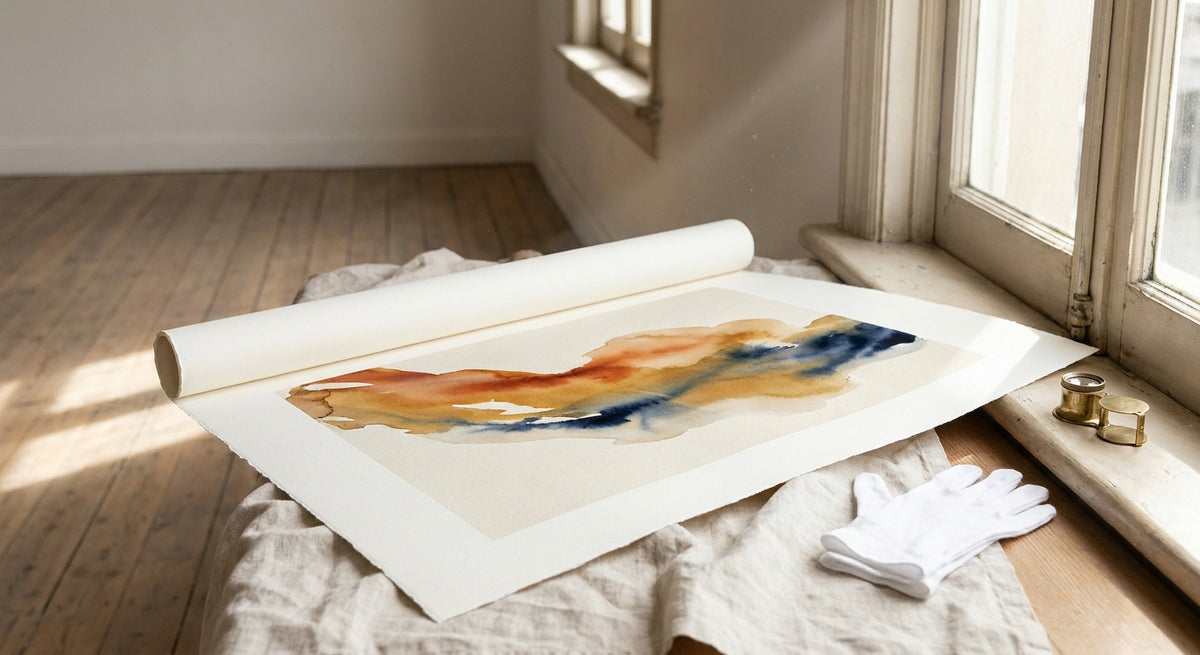
Museum-quality fine art papers are typically made from carefully selected fibres, including 100% cotton rag, and are formulated to be acid-free and resistant to deterioration.
One example is 350 GSM Museum Etching paper, a heavyweight cotton fine art paper known for its natural white tone and beautifully textured matte surface.
Unlike standard decorative poster paper, premium cotton rag paper offers a distinctive tactile quality. Its surface absorbs and holds pigment inks in a way that supports rich colour reproduction and delicate detail.
The result is a print with an elegant, gallery-quality finish.
Cotton rag paper also provides important preservation benefits. Acidic materials can contribute to yellowing, discolouration, and brittleness over time, whereas appropriately manufactured archival papers are designed for long-term stability.
However, archival paper alone does not guarantee a 100-year lifespan. The inks, printing process, framing materials, and display conditions are equally important.
3. High-Resolution Printing: Every Detail Matters
Resolution plays an important role in reproducing fine art accurately.
Professional fine art printing typically uses high-quality digital artwork prepared at an appropriate resolution, often around 300 pixels per inch (PPI) at the intended print size.
The printer itself may operate at output resolutions such as 1440 dots per inch (DPI) or higher, depending on the equipment and print settings.
These are different measurements: PPI describes the digital image resolution, while DPI describes the printer's output capability.
When high-resolution artwork is combined with advanced inkjet technology, professional colour management, and archival materials, the result can capture intricate lines, smooth gradients, and delicate visual textures with remarkable precision.
For art collectors and interior design enthusiasts, these details can make the difference between an ordinary decorative print and a truly premium fine art reproduction.
Giclée vs. Poster: What's the Real Difference?
It's easy to assume that two prints of the same artwork should look alike.
But once you experience a museum-quality giclée print in person, the differences in materials, colour reproduction, and finish can become much more apparent.
Standard Decorative Posters
- Commonly printed on commercial poster paper or coated stock.
- May use conventional CMYK printing, toner, or other commercial printing methods.
- Colour accuracy and detail depend on the equipment and materials used.
- Often produced for affordable, everyday decoration.
- Longevity varies considerably according to inks, paper, and display conditions.
Museum-Quality Giclée Prints
- Produced using professional fine art inkjet printing technology.
- Typically use archival pigment inks.
- Printed on premium acid-free fine art papers or archival canvas.
- Designed to reproduce delicate tonal differences, intricate details, and rich colour accurately.
- Can offer excellent long-term preservation when produced and displayed under appropriate conditions.
The most important difference isn't simply that one costs more.
It's the combination of visual reproduction, material quality, and longevity.
A well-produced giclée isn't just designed to fill an empty wall. It's created to preserve the artistic character of the original work.
Can You See the Difference With the Naked Eye?
Yes. The difference between a standard decorative print and a professionally produced giclée can be visible without magnification, especially when the physical prints are viewed side by side.
Colours may appear more nuanced, gradients smoother, and fine details more clearly defined.
Consider an artwork with a deep blue background and delicate transitions into violet, grey, and black. An advanced multi-ink giclée process can reproduce these tonal changes with exceptional subtlety.
Similarly, abstract paintings with soft neutral palettes, layered colour fields, or intricate brushwork benefit from precise colour reproduction.
The natural texture of premium fine art paper also contributes to the overall appearance, giving the artwork a distinctive matte finish and refined presentation.
Not every giclée will automatically look better than every poster; the quality of the original image, printing equipment, and materials matters. But when produced professionally, giclée printing offers a level of precision and material quality that makes it a preferred choice for fine art reproduction.
Indian Art Styles & Abstract Paintings: Why Giclée Makes a Difference
Much of the conversation around giclée printing focuses on Western fine art. Yet India's artistic traditions, alongside the growing popularity of contemporary abstract paintings, provide compelling examples of why this printing process matters.
Preserving the Intricate Details of Traditional Indian Art
Indian art forms such as Madhubani, Pichwai, Rajasthani miniature, and Warli painting are celebrated for their distinctive visual languages.
From intricate patterns and delicate outlines to traditional motifs and complex colour compositions, these artworks demand careful reproduction.
Consider a Pichwai painting with detailed floral patterns, rich gold tones, and elaborate decorative elements. Or a Rajasthani miniature filled with fine brushwork, intricate architectural details, and subtly layered colours.
Professional giclée printing can capture these visual characteristics with remarkable precision.
Archival pigment inks help reproduce rich tones and delicate colour variations, while premium fine art papers complement the character of the artwork.
Although printing cannot recreate the actual metallic reflection of genuine gold leaf or the raised texture of original paint, it can reproduce their visual appearance with impressive detail.
The result is a fine art reproduction that respects the craftsmanship and artistic heritage of the original composition.
Abstract Paintings: Where Colour Accuracy Becomes Everything
Abstract paintings offer an equally powerful example of the advantages of giclée printing.
Unlike highly detailed representational art, abstract artwork often relies on relationships between colours, shapes, textures, and tonal transitions to create its visual impact.
A minimalist beige abstract painting may contain dozens of subtle tonal variations. A bold geometric composition might depend on the precise contrast between vivid red, cobalt blue, and deep black.
An expressive contemporary abstract painting may include overlapping brushstrokes, fluid gradients, and complex layers of colour.
These details can be difficult to reproduce accurately with basic printing processes.
Professional giclée printing is particularly well suited to capturing:
- Soft gradients and subtle tonal transitions.
- Rich, saturated colours in bold contemporary compositions.
- Delicate variations in neutral, earthy, and pastel palettes.
- Intricate lines, layered pigments, and the visual appearance of brushstrokes.
- Deep blacks, shadow details, and balanced colour contrast.
Whether it's a large statement abstract painting for a living room or a minimalist composition for a modern bedroom, the quality of the print contributes directly to how the artwork feels within the space.
At Dessine Art, our curated collection brings together traditional Indian art, contemporary abstract paintings, botanical artwork, timeless masterpieces, and works by emerging artists.
Our museum-quality selections use premium fine art materials, including heavyweight cotton rag papers and archival pigment inks, to reproduce artwork with exceptional care and attention to detail.
The goal is simple: to honour the colours, details, and artistic expression that make every artwork unique.
Are Giclée Prints Considered Fine Art?
Absolutely. Giclée printing is widely used by professional artists, photographers, galleries, and fine art publishers.
However, it's important to understand the difference between an original painting and a fine art reproduction.
An original painting is a physical artwork created directly by an artist. A giclée reproduction captures that existing artwork through a professional printing process.
For artists working digitally, a giclée can also serve as the original physical presentation of their artwork.
Some artists additionally release signed and numbered limited-edition giclée prints.
These editions may include certificates of authenticity, details of the printing materials, and edition numbers that establish their provenance.
When properly documented and authorised by the artist, limited-edition prints can carry collectible value of their own.
The quality of the print alone doesn't make it a limited edition or establish its authenticity. The artist's authorisation, edition documentation, and provenance are what matter.
For buyers who appreciate fine art but aren't necessarily looking to purchase an original painting, high-quality giclée prints provide an accessible way to bring exceptional artwork into their homes.
How Long Does a Giclée Print Last?
One of the biggest reasons collectors choose archival giclée prints is their potential longevity.
High-quality pigment inks, when paired with suitable archival papers, can achieve projected lifespans exceeding 100 years in certain tested combinations and under specified display conditions.
However, no printing process can guarantee that every artwork will last a century regardless of how it is displayed.
The lifespan of a fine art print depends on several factors, including:
- The lightfastness of the pigment inks.
- The quality and chemical stability of the paper or canvas.
- Exposure to direct sunlight and ultraviolet radiation.
- Temperature and humidity.
- The quality of framing and backing materials.
A museum-quality giclée produced with appropriate materials and cared for correctly is designed for long-term preservation rather than temporary decoration.
This makes it particularly appealing to people who prefer to invest in artwork they can enjoy for years instead of frequently replacing inexpensive prints.
How to Care for Giclée Prints in an Indian Home
India's varied climate makes proper artwork care particularly important.
From humid monsoon seasons to strong summer sunlight, environmental conditions can affect paper, inks, and framing materials.
Fortunately, a few simple precautions can help preserve the appearance of your artwork.
Choose the Right Framing
Professional framing does more than improve the appearance of an artwork.
Acid-free mounting and backing materials help reduce the risk of deterioration over time.
For additional protection, consider UV-filtering glass or acrylic, which reduces exposure to harmful ultraviolet radiation.
Premium framing also provides structure, support, and a finished gallery-style presentation.
Avoid Direct Sunlight
Even prints produced with archival inks should be protected from prolonged direct sunlight.
Strong sunlight can accelerate colour fading over time, even when protective glazing is used.
For best results, display your artwork away from windows receiving intense direct sunlight.
Manage Humidity and Moisture
Excessive humidity can contribute to paper distortion, mould growth, and damage to framing materials.
In coastal regions or during the monsoon season, keeping artwork in a reasonably ventilated, dry environment can help minimise these risks.
Avoid displaying valuable paper artwork in areas exposed to frequent moisture or significant temperature fluctuations.
With the right materials, framing, and care, a museum-quality giclée print can remain a beautiful part of your home for generations.
A Print Worth Keeping
The difference between a standard poster and a museum-quality giclée print isn't something you necessarily have to wait years to notice.
It can be visible to the naked eye from the very first glance.
Richer colour reproduction, smoother tonal transitions, sharper details, and the natural character of premium fine art paper create a visual experience that conventional decorative printing may struggle to match.
Look a little closer, and the difference becomes even more apparent.
The subtle variations in an abstract painting, the intricate patterns of traditional Indian artwork, or the delicate brushwork of a classical masterpiece can take on a new level of depth when reproduced with precision.
And while the visual difference is something you can appreciate immediately, archival materials are designed to help preserve that beauty for years to come.
If you're asking these questions before buying art, you're already thinking like a collector. That instinct is worth trusting.
Art chosen carefully, printed with intention, and framed beautifully deserves to remain part of your space for generations.
At Dessine Art, we bring together a thoughtfully curated selection of abstract paintings, contemporary artwork, traditional Indian art, and timeless masterpieces. Our museum-grade printing options combine premium cotton rag fine art papers, including 350 GSM Museum Etching paper, with archival pigment inks for exceptional colour reproduction and long-term preservation.
Complemented by professional framing options in wood, metal, and elegant gallery-style finishes, our framed artwork arrives ready to hang.
Because great art deserves to look extraordinary today and remain beautiful for generations.
Explore the Dessine Art collection and discover museum-quality art prints, abstract paintings, and beautifully framed artwork designed to transform your walls.